The Book of the Month by Al Silverman
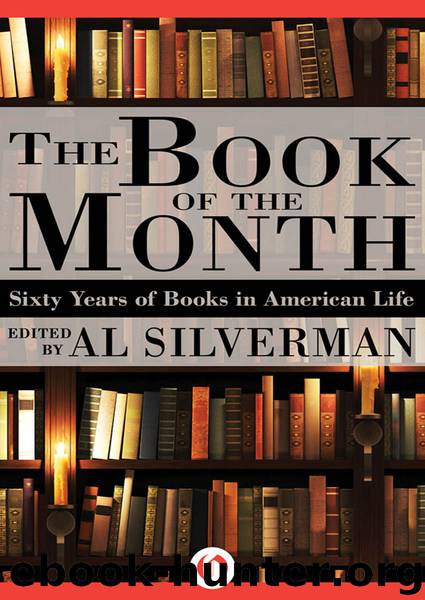
Author:Al Silverman
Language: eng
Format: epub
Publisher: Open Road Integrated Media
The actor and playwright Emlyn Williams got a start on his autobiography with George, published in 1962. The playwright, director, and novelist Garson Kanin provided the BOMC audience with “the shapes and colors of this strangely structured personality.”
Emlyn Williams by Garson Kanin
It was during an intermission at Wyndham’s Theatre in London. I was giving my visiting friend a run-down on the British theater community.
“Now Emlyn Williams,” I said, “is different.”
“Different from whom?” asked my friend.
“From Emlyn Williams,” I heard myself say.
My friend gave me an “Oh” and a worried look.
Before I could elaborate, the house lights dimmed, and our exchange joined that monumental slag heap of unfinished conversations.
I am grateful for the opportunity to explain now.
Consider two plays in the standard repertoire of drama in the English language—The Corn Is Green and Night Must Fall. The first: a profound, moving and poetic exploration of a noble theme—human potential. The second: a classic model of a thriller. Is it possible that both these plays could have been written by the same playwright? It is not only possible but true.
Consider next the performances of the leading male roles in these plays. In The Corn Is Green, Morgan Evans, the Welsh mine boy, is taken from beneath the earth—“where the corn is green”—remolded, and realized in the crucible of love and determination. It is a performance which remains in the memory of all who saw it. In Night Must Fall it is a psychopath, Dan, who possesses not only the charm of the devil but also his intent. What have these two performances in common? Nothing, except that Emlyn Williams created them both. Here, then, are four contributions to the history of the modern British theater, any one of which would earn a place in that record. All four were made by Emlyn Williams.
Does it begin to be clear what I meant by “different”?
The shapes and colors of this strangely structured personality do not end here. There have been other plays—comical, tragical, historical, inspired, indifferent, artistic and commercial. In each of them another aspect of an ever-flowing cornucopia of creativity is revealed.
One stands out: a play called Pen Don. On an evening in 1954 I saw it performed by a group of amateurs in Swansea, Wales, upon a raised platform in the reading room of the Swansea Museum of Natural History. The director of the production, Tyrone Guthrie, preoccupied with the job of mounting the play (which, in this case, involved painting some of the scenery and sewing a wig or two), had invited me to the wrong night. Thus, instead of attending the gala opening I had expected, I attended the somewhat less than gala first dress rehearsal. In the musty, book-lined, creaky old room, the play began. The players had neither the experience nor the confidence to play the play. No matter. The play played them. The result was a soaring performance of a transcendent, inspired play. The fact that Pen Don has never been performed commercially in either London or New York is nothing against it, but only another sign of the theater’s trouble.
Download
This site does not store any files on its server. We only index and link to content provided by other sites. Please contact the content providers to delete copyright contents if any and email us, we'll remove relevant links or contents immediately.
4 3 2 1: A Novel by Paul Auster(12375)
The handmaid's tale by Margaret Atwood(7757)
Giovanni's Room by James Baldwin(7326)
Asking the Right Questions: A Guide to Critical Thinking by M. Neil Browne & Stuart M. Keeley(5758)
Big Magic: Creative Living Beyond Fear by Elizabeth Gilbert(5754)
Ego Is the Enemy by Ryan Holiday(5413)
The Body: A Guide for Occupants by Bill Bryson(5080)
On Writing A Memoir of the Craft by Stephen King(4935)
Ken Follett - World without end by Ken Follett(4723)
Adulting by Kelly Williams Brown(4565)
Bluets by Maggie Nelson(4547)
Eat That Frog! by Brian Tracy(4525)
Guilty Pleasures by Laurell K Hamilton(4439)
The Poetry of Pablo Neruda by Pablo Neruda(4097)
Alive: The Story of the Andes Survivors by Piers Paul Read(4018)
White Noise - A Novel by Don DeLillo(4002)
Fingerprints of the Gods by Graham Hancock(3996)
The Book of Joy by Dalai Lama(3976)
The Bookshop by Penelope Fitzgerald(3844)
